Mar 14

Microsoft has released Service Pack 1 for its Visual Studio 2010 flagship integrated development environment (IDE). Visual Studio SP1 provides many new features, performance improvements, and bug fixes including:
- Stand-alone Help Viewer 1.1
- Silverlight 4 support
- Basic Unit Testing support for .NET 3.5
- .NET Framework 4 improvements
- Performance Wizard for Silverlight
- Visual Basic Runtime embedding
- IntelliTrace for 64-bit and SharePoint
- Fix for partial or mixed Visual Studio installations
- IIS 7.5 Express support
- SQL Server CE 4 support
- Razor support for ASP.NET Web Pages and MVC 3
- Web Platform Installer integration
- HTML5 and CSS3 preliminary support
- WCF RIA Services localized and supported
- XAML Editor/Designer improvements
- XAML Style IntelliSense
- C++ MFC-based GPU-accelerated graphics and animations
- New AMD and Intel instruction set support
Download Visual Studio 2010 SP1
Full Description of VS 2010 SP1
Tips on Installing VS 2010 SP1
Nov 23
I recently wrote how Visual Studio 2010 is very slow on my fast PC, taking 25-30 seconds to start up. Thanks to a Microsoft employee who helped me but wishes to remain anonymous, my problem is solved.
The VMWare add-in, VMDebugger, causes Visual Studio 2010 to load very slowly on my fast PC.
Continue reading »
Nov 20
UPDATE: Problem solved! The VMWare add-in VMDebugger was the culprit.
I recently upgraded to Visual Studio 2010 and had a rude awakening: VS2010 starts up very sloooooow. I have a 2-year-old dual core laptop. Visual Studio 2008 starts in about 3 seconds. The first time I start VS2010, it takes about 55 seconds. Subsequent startups take 25-30 seconds. The hard drive doesn’t thrash; instead, the splash screen just sits there for a half minute before the IDE finally opens.
Continue reading »
Apr 12
 Microsoft is releasing Visual Studio 2010, .NET Framework 4.0, and Silverlight 4 at the Visual Studio Developer Conference in Las Vegas. VS 2010 and .NET 4 are available today, and Silverlight 4 will be available to download later this week.
Continue reading »
Feb 16
The Release Candidate (RC) for Visual Studio 2010 and .NET Framework 4.0 is now available to the public. The biggest change from Beta 2 is a major improvement to Visual Studio performance, specifically as it relates to loading solutions, typing, building and debugging. The RC includes a “go-live license” for companies that wish to deploy Visual Studio 2010 in their production environment.
Download VS 2010 and .NET 4.0 RC
Jan 14
Do you need help convincing your boss that your company needs to upgrade to Visual Studio 2010? Or perhaps you are looking for additional ammo in your .NET vs. Java religious wars with your programming colleagues?
Microsoft has produced a Silverlight-based “Myth Busting Matrix” for Visual Studio. This nifty web tool details the benefits of upgrading to Visual Studio 2010 and helps dispel some widely-held myths about Visual Studio and the Microsoft .NET Framework. You can browse all three supported versions of Visual Studio (2005, 2008 and 2010) by your areas of interest and click on the myths for more information.

Visual Studio Myth Buster
Jan 14
Zain Naboulsi, a Senior Developer Evangelist at Microsoft, has started the “Tip of the Day” series for Visual Studio 2010, taking the reins from Sara Ford.
Visual Studio 2010 Tip of the Day
Oct 23
The second beta version of Visual Studio 2010 and Microsoft .NET Framework v4.0 are now available. VS 2010 and .NET 4.0 deliver significant new capabilities and improvements. The Beta 2 release was focused on performance, stability, and the integration of the overall feature set. The development team is awaiting our feedback on the product and preparing for the final release candidate (RC). Beta 2 includes a “go-live” license, which means you can start using these tools for your production projects.
VS 2010 and .NET 4.0 are slated to be released on March 22, 2010.
Download VS 2010 and .NET 4.0 Beta 2
More details about Beta 2 from Scott Gu
Jun 11
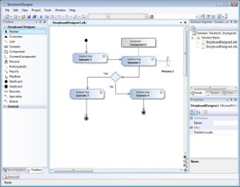 If you create software development tools, you’ll want to consider building on the Visual Studio Shell. A streamlined Visual Studio development environment, the Visual Studio Shell provides the core foundation so you can focus on building your application’s unique features. Flexible customization options help you deliver optimized experiences for specific markets. Note that the Visual Studio Shell is royalty-free for building and deploying applications.
The key benefits of the Visual Studio Shell:
- Faster development. The Visual Studio Shell accelerates development by providing a base integrated development environment that can host custom tools and programming languages.
- A familiar environment. Developers can build on the Visual Studio platform and provide end users a familiar user interface, speeding the learning curve for both.
- Optimized for languages and tools. Created in response to requests from our partners, the Visual Studio Shell gives you the option of integrating your tools with Visual Studio or creating an isolated, custom-branded application.
Visual Studio Shell
May 20
Documentation for the next generation of the Visual Studio, the .NET Framework, and Windows Presentation Foundation (WPF) is now publicly available at MSDN.
Visual Studio 2010 Docs
.NET Framework 4 Docs
WPF Docs

